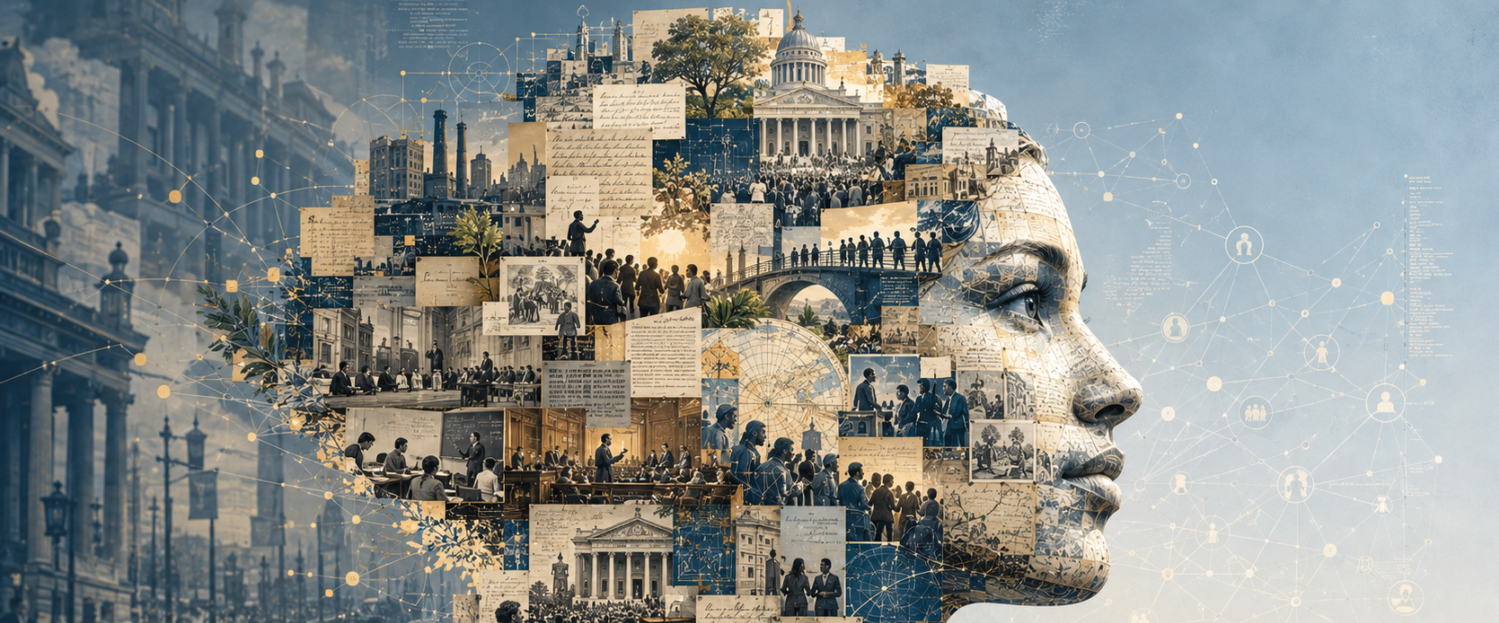
No personal civilisation is wholly identical to that of any other individual. Differences in upbringing, experience, social position, personality characteristics and information sources make complete agreement practically unlikely. Individuals may nevertheless share sufficient civilisation elements to live and work together.
When individuals within a social circle develop sufficiently corresponding conceptions, norms, expectations, courses of action, goals and ideals on matters relevant to that circle, a certain commonality arises. Members need not agree about everything. They must, however, have sufficient shared expectations to understand and predict one another’s conduct to some degree and to make common action possible.
The sufficiently shared and socially operative elements of the personal civilisations of the members of a social circle are called its circle civilisation here. Civilisation elements can be distinguished separately for analytical purposes, but often function coherently within personal and circle civilisations. A conception of reality may, for example, be connected with particular norms, behavioural expectations and goals. A change in one element may therefore also affect other related elements. The individuals concerned need not consciously distinguish this coherence in full, nor need it be explicitly recorded.
A circle civilisation consequently does not exist independently of individuals, but neither is it simply the sum of their personal convictions. It consists of those elements that are sufficiently shared to make common expectations, judgement, cooperation and cohesion possible within the social circle concerned.
Civilising begins immediately after birth. At that stage the individual is strongly dependent on parents or caregivers and continually absorbs civilisation elements through voices, touch, facial expressions, responses and other perceptible conduct. Teachers and an increasing number of other persons and sources are added later. Many expectations are initially presented from outside and may subsequently be internalised.
As individuals grow older, both the number of sources of civilising and the variety of civilisation elements presented increase. Alongside parents and caregivers, friends, peers, teachers, colleagues, public figures, media and institutions become important sources. As an individual becomes more independent, that individual can also increasingly determine which persons, social circles and information sources to seek out or avoid.
Not all sources carry equal weight in this transmission. People do not adopt a conception solely because they encounter it. Civilisation elements are more likely to be adopted from persons and institutions regarded as reliable, expert or worthy of emulation than from distrusted sources.
The assessment of a source, however, itself takes place from the already formed personal civilisation. What someone considers credible depends partly on existing conceptions of expertise, authority, evidence and reliability. This creates an important feedback mechanism. New ideas are assessed by standards produced through previous civilising.
Sources that correspond to existing convictions and norms will therefore often gain trust more readily than sources that conflict strongly with them. Conversely, views originating from an already distrusted source may be rejected before they have been considered in depth on their merits. Civilising is therefore not a process in which all available ideas compete on equal terms.
The number of sources from which the same or corresponding information appears to originate may affect its perceived credibility. When an individual receives the same information from several sources considered mutually independent, the likelihood increases that the information will be regarded as credible. This effect may also occur when those sources in fact rely wholly or partly on the same original source.
This mechanism acquires a collective dimension when the members of a social circle share many civilisation elements. They may consequently regard the same persons and institutions as authoritative, reliable or worthy of emulation. When this occurs, the same ideas may reach and be adopted by large numbers of individuals through the same sources. The existing circle civilisation then partly determines which new ideas readily gain access to the circle. Moreover, as a civilisation element reaches more members of a social circle, the likelihood that it will spread further within that circle increases.
Under such conditions, not every new idea has the same likelihood of spreading. The likelihood that an idea will be incorporated into personal civilisations and subsequently transmitted depends, among other things, on the extent to which it corresponds to already present civilisation elements. Trust in the source, the simplicity and comprehensibility of the idea, its perceived usefulness, the frequency of exposure, the reach of its dissemination and the social consequences of acceptance or rejection also play a part.
Ideas that are more readily understood, accepted and transmitted under existing social conditions may consequently spread more widely than competing ideas. This does not necessarily mean that they are true or morally better. It means only that the social conditions are more favourable to their transmission and reproduction.
Individuals are not civilised solely through direct contact with other individuals. Civilisation elements may also be transmitted through recorded expressions, such as books, images, films, sound recordings and digital media, without the original creators still being involved in the transmission. Technical information systems may additionally help select, order, combine, modify or generate the information and expressions of ideas presented to individual users. Such systems may therefore also constitute a source of civilisation elements.