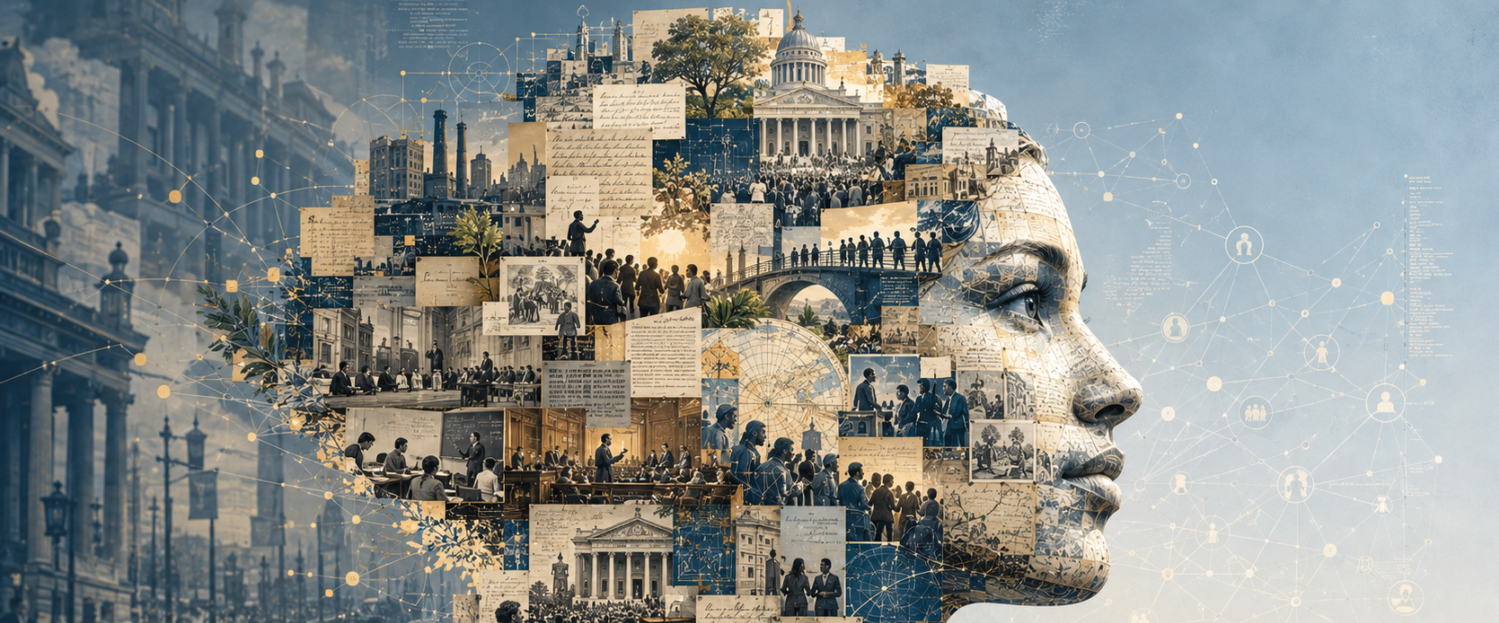
At any given moment, every individual possesses a configuration of conceptions and assumptions about reality, norms and values, behavioural repertoires, goals and ideals. People hold views about what exists and what has happened, about causes and consequences, about what they regard as credible knowledge, and about which persons or institutions they trust. They apply standards by which they judge conduct, persons and social conditions as good or bad, right or wrong, desirable or undesirable. They also possess behavioural repertoires: possible courses of action that they can employ in a variety of social situations. Finally, they have conceptions of personal or social conditions and outcomes that they regard as worth pursuing.
Taken together, these elements may be understood as the ideas that give content to what is called here an individual’s personal civilisation. The concept of civilisation carries no evaluative meaning in this usage. It does not imply that one person is more civilised, developed or morally better than another. It denotes the historically formed configuration through which an individual interprets the surrounding world, judges situations and acts within them.
A personal civilisation does not arise at one particular moment, nor is it ever definitively completed. It is the result of a continuous process of perception, upbringing, education, experience, media use and interaction with others. From birth onwards, an individual encounters the conduct, expectations, explanations, judgements and courses of action of others. Some of these are adopted; others are rejected, modified or later reinterpreted. New experiences may also modify previously formed conceptions, relativise norms, give rise to new goals or expand existing behavioural repertoires.
This continuous process through which civilisation elements are formed, transmitted, internalised, maintained, interpreted, modified, strengthened, weakened or rejected is called civilising here. Civilising is therefore not merely upbringing or education. It encompasses the entire process through which personal civilisations arise and change over the course of a life.
Personal civilisation largely structures an individual’s everyday thinking, judgement, volition and conduct. It does not, however, determine conduct mechanically. The actual outcome arises through interaction with personality characteristics and the concrete situation. Moreover, people possess different and sometimes mutually contradictory civilisation elements. Which of these become operative in a particular situation depends partly on the social circle and social environment in which the individual acts.
It is useful in this connection to distinguish between social circles and spheres. A social circle is a concrete and recognisable association of individuals connected by more or less enduring relations and thereby mutually dependent. A family is a social circle, as are an enterprise, association, political organisation and state. A sphere is not a concrete social circle, but a category of circles that perform a corresponding social function and have associated characteristic roles, relations and expectations.
The same individual may simultaneously belong to several social circles and may therefore behave differently in different social environments. Someone may regard strongly hierarchical relations as self-evident within an enterprise while emphatically pursuing equality within the family. Conduct deemed appropriate in a sports club may be considered inappropriate in a court of law. Norms and values may likewise differ between spheres and may even partly conflict. Personal civilisation must therefore not be understood as a single, wholly consistent system that is expressed in the same way under all circumstances.