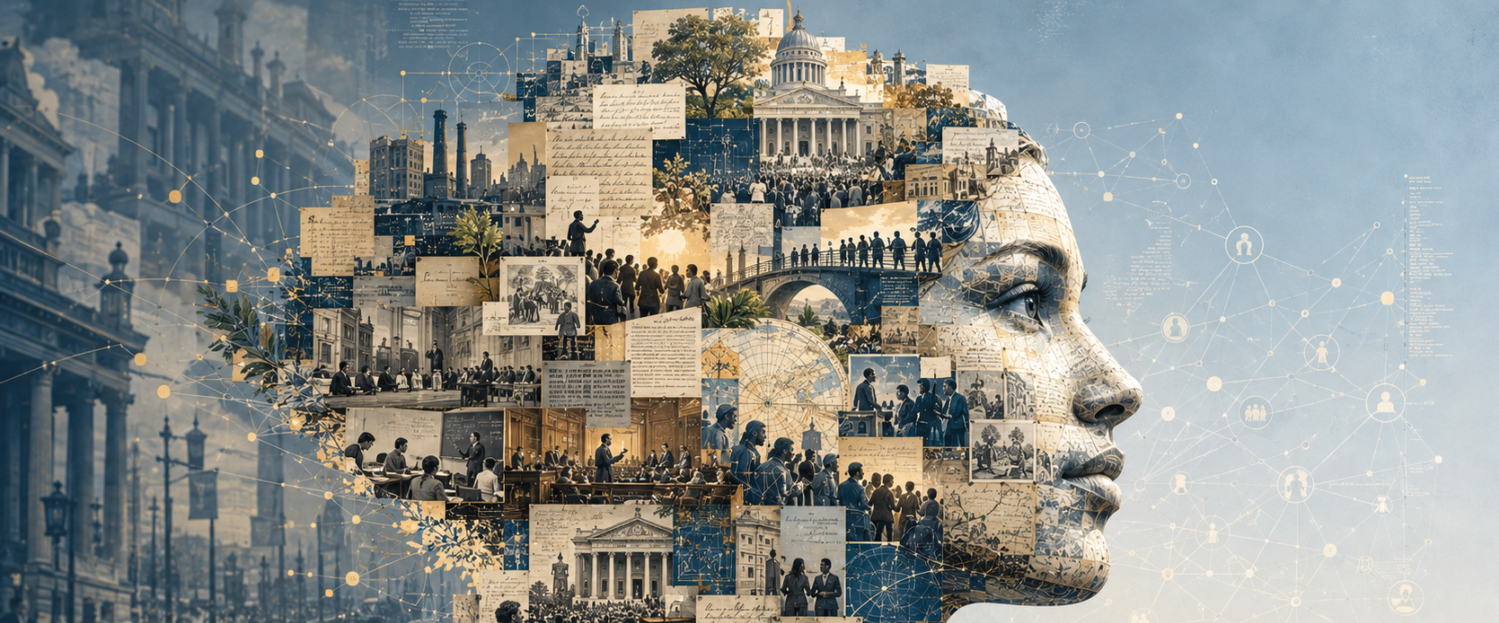
“It is remarkable … to see a million people bowed beneath the yoke of a wretched servitude, not because they are compelled to do so, but solely … because they are bewitched and fascinated by the name of one person, whose power they need not fear … whose qualities they need not admire, since he is inhuman and cruel towards them.” – Étienne de La Boétie, The Discourse of Voluntary Servitude; originally La Servitude volontaire (ca 1553)
“The social constraint towards self-constraint.” – Norbert Elias (1933)
“If you want to change the world, first understand how the world changes”. – Dick H. Ahles (2026)
❦
A Theory of Civilising and Social Change
Version 1.1 | 4 October 2026
How do ideas become social power?
A scientific theory of civilising and social change.
Why do people come to regard particular ideas, norms and institutions as natural, legitimate or desirable? Why do social orders remain remarkably stable for long periods — and sometimes change profoundly? And how can actors deliberately contribute to such change?
The Art of Revolution develops a formal theory for analysing these processes.
It takes its intellectual point of departure from Norbert Elias’s understanding of civilisation as an ongoing social process, but develops from it a distinct theoretical framework for explaining stability, power and social change.
Its starting point is simple: social change ultimately operates through individuals, but individuals are formed within social circles, institutions and existing civilisations. Ideas acquire social power when they are learned, shared, acted upon and institutionalised.
The theory seeks to explain both stability and change — including the possibilities and limits of purposive political action.
The theory is descriptive rather than normative. It does not determine which political ideas are true, morally right or desirable. It provides a framework for empirical investigating how civilisations and social orders are formed, maintained and changed.
❦
Explore the theory
Outline – A readable introduction to the theory and its argument.
Axioms – The four analytical assumptions on which the theory rests.
Definitions – The formal conceptual framework.
Propositions – The 100 propositions that constitute the formal theory.
Domains – The formal conceptual framework.
Literature – Sources and intellectual background.
❦
About this publication.
This website is designed as a web-native scientific publication. The theory can be explored linearly, through its formal elements, thematically through Domains, or by search. Definitions, propositions and domains are separately addressable and dynamically connected.
❦
About the author
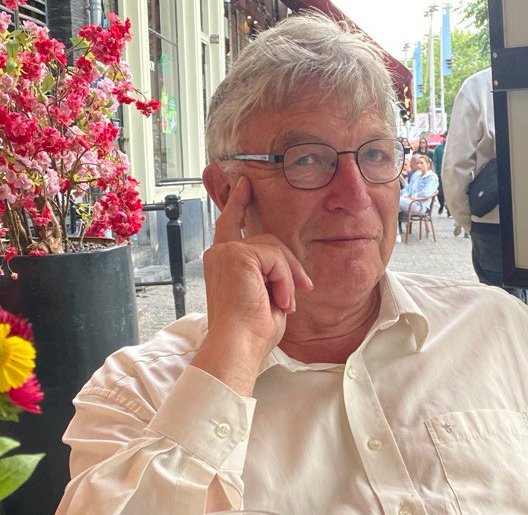
Dick H. Ahles is an independent researcher in political and social theory. He studied political science at Vrije Universiteit Amsterdam and has worked as an executive, entrepreneur and organisational adviser. The Art of Revolution brings together a long-standing interest in civilisation, political action and social change.
Related Research
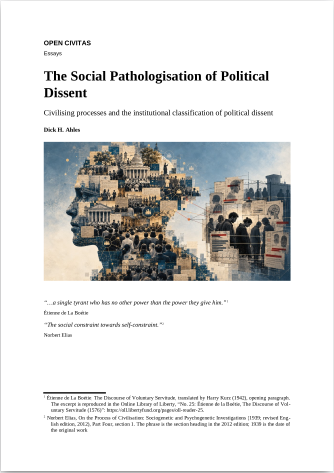
The Social Pathologisation of Political Dissent applies the theoretical framework developed in The Art of Revolution to the social and institutional classification of political dissent.
The Art of Revolution is an independent research project

Organisation for Research and Publications